
Hollywood depicts bunkers as luxury features that only the rich and powerful have. In reality, reinforced shelters are going mainstream as utilitarian assets — not elite status symbols for the ultrawealthy. Civil unrest and societal uncertainties, including the COVID-19 pandemic, have emphasized the practicality of these in the past several years.
Videos of police stations in flames after the George Floyd incident and during the resurgence of the Black Lives Matter movement showed everyday people that a large-scale societal breakdown was plausible. Many felt vulnerable because they realized they couldn’t rely on law enforcement to protect them during civil unrest. More of the public now believe they should have a highly secure space at home with a reinforced door to stay safe during an extended disturbance to public order.
Security-conscious people may wonder whether they should build bunkers or safe rooms. Generally, bunkers are fortified underground structures for storing critical supplies like ammunition and evading enemy raids during wartime. On the other hand, a safe room is a secure hiding spot anywhere inside or outside your house where you and your family can retreat during a home invasion or natural disaster. The construction costs of bunkers versus safe rooms are also night and day.
Regardless of which kind of space you choose, it should be impregnable and concealed. The best doors for bunkers and safe rooms for homes can obscure their presence and remain unscathed when attacked. High-security prefabricated or customized hiddendoors are your safest investments.
Prefab hidden security doors from the Hidden Door Store have minimal forward-facing seams to avoid detection. These steel-reinforced doors have two-inch rock wool insulation, 16 locking bolts, fixed locking studs, armored anchors and a pick-resistant lockset. Manganese steel plates surround the locking mechanism to prevent drilling and other forms of manipulation, providing dependable forced-entry protection.
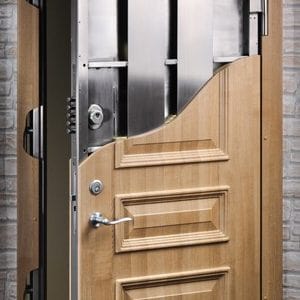
Custom hidden security doors from Creative Home Engineering have similar advanced locking mechanisms, except you can tailor them to your unique specifications to improve their camouflage and fit your desired security level.
Modern bunker designs lend themselves to various style preferences, but ensure you have these must-have features.
Clean water is a survival bunker essential you can’t live without. It can come from an external network or an underground source. The Federal Emergency Management Agency recommends at least a gallon of water for every person or pet daily for food preparation and hygiene, so keep an adequately sized tank. You should also drink half a gallon daily to stay hydrated.
Invest in water purification or distillation to avoid getting sick at the worst possible time. Recycling gray water also conserves the finite clean water supply.
Your bunker should have a military-grade air filtration system to catch lethal pollutants from nuclear, biological and chemical threats, allowing you to breathe freely while in hiding.
Reduce exposure to harmful contaminants to help your air filtration system operate more efficiently. Your shelter’s reinforced door should have suitable seals to prevent toxic substances from entering. Creative Home Engineering fabricates them based on doorway measurements to minimize gaps for maximum airtightness.
Bunker walls must contain layers of thick, dense materials to safeguard you from fallout particles. For instance, approximately 3.5 inches of packaged earth can halve gamma-ray radiation levels, as can about 2.5 inches of concrete or 0.4 inch of lead.
Bunker security systems rely on electricity, so equip your shelter with a backup power system to keep everything running during outages. Backup batteries power critical systems, allowing you to stay more comfortable in your hideaway.
Allocate sufficient space for your food and medical supplies. Stockpile them in cool, dry locations for long-term durability.
Unlike other survival bunker essentials, insulation tends to be low on many people’s priority lists. However, sufficient insulation is instrumental in regulating your bunker’s climate. It stabilizes your shelter’s temperature levels to minimize your hydration needs and prevent supply spoilage.
In 2023, a third of American adults collectively spent $11 billion to prepare for a doomsday scenario. High-end shelters with no budget constraints can include advanced security systems, self-sustaining power and water systems, living quarters and other conveniences built with state-of-the-art technology. Depending on customization, these projects can easily cost six digits.
Fortunately, any security contractor who knows how to build a safe room would attest that the luxury survival bunkers you see in the media aren’t the standard. Affordable home bunker and safe room ideas can get the job done.
A shelter with a prefab steel door, reinforced walls and a small air filtration system is budget-friendly and can provide basic protection. You can spend less than $15,000 on supplies to convert an existing space into a panic room. Choosing a custom door over a prefab one costs more, but hiding the access point to your shelter is worth the expense.
Creative Home Engineering has handled numerous panic room conversion projects and fabricated countless high-security concealed doors for bunkers. Reach out today to discuss your shelter ideas and plan your project with your budget in mind.