
Concealing a room makes it more secure. The mechanical system you choose will dictate the hidden room’s spatial footprint and long-term functionality. That’s why it’s best to determine whether a sliding or hinge system aligns better with your floor plan before exploring door materials and security grades.
A sliding bookcase track system operates by moving linearly along concealed upper and lower tracks. It moves parallel to the adjoining wall rather than swinging into the room.
To enter and exit, you must manually displace 100% of the unit’s mass, which means its sliding tracks generate more friction than hinged doors. Operating a heavy, fully loaded bookcase requires overcoming substantial inertia, which often requires 30 to 40 pounds of lateral push force just to initiate movement.
Because of these load-bearing demands, the track system’s design must be matched to the required security threat level. For a minimal-security application, which makes up 15% of Creative Home Engineering‘s projects, trackless hanging systems could suffice.
However, for high-security applications that use ballistic-rated steel cores, heavy-duty, floor-recessed track systems are mandatory. These reinforced tracks prevent the door from being derailed by blunt force and maintain the floor’s seamless aesthetic.
A sliding bookcase door maximizes usable square footage. It glides laterally, requiring zero clearance directly in front of or behind the opening. This makes it ideal for narrow corridors and heavily furnished rooms.
Consider a scenario where a homeowner plans to leave the safe room open throughout the day. A sliding door can retract into a wall pocket, exposing only a highly finished leading edge. This creates a seamless architectural transition rather than the imposing look of an open, heavy vault door hanging in a hallway.
While it can be manually operated, a sliding hidden door is often paired with automated motorization because of its heavy push-force requirement. This system relies on advanced computers, drive belts and safety sensors. The actuation deliberately takes three to five seconds to complete its stroke. Operating slower than Hollywood depictions is an engineered safety constraint to prevent crushing injuries from the door’s extreme momentum.
To ensure a smooth glide, precision engineering works around the heavy lateral movement. Objects placed on the shelves will stay put without falling. This makes the sliding bookcase door perfect for large openings and dramatic hidden room entrances.
A pivot system distributes the load close to the hinge axis, which reduces the kinetic effort necessary to move the door. High-end systems have precise ball-bearing hinges that render the rotational movement virtually frictionless. This removes the costly need for motorization.
Hinged systems are easier to integrate flush against existing wainscoting, trim and millwork. When properly engineered with tight tolerances, the unit acts as a true ghost door, revealing no visible clues of an entrance.
Beyond security, integrating these analog, concealed spaces can add highly desirable, functional square footage to a property. They can improve appraisal reports without the need for exterior expansion. Buyers and appraisers alike recognize the premium value of custom architectural features that don’t require complex electrical maintenance.
If you prioritize reliability, secure concealment and minimal upkeep, a hinge configuration is the best hidden bookcase door on the market for you.
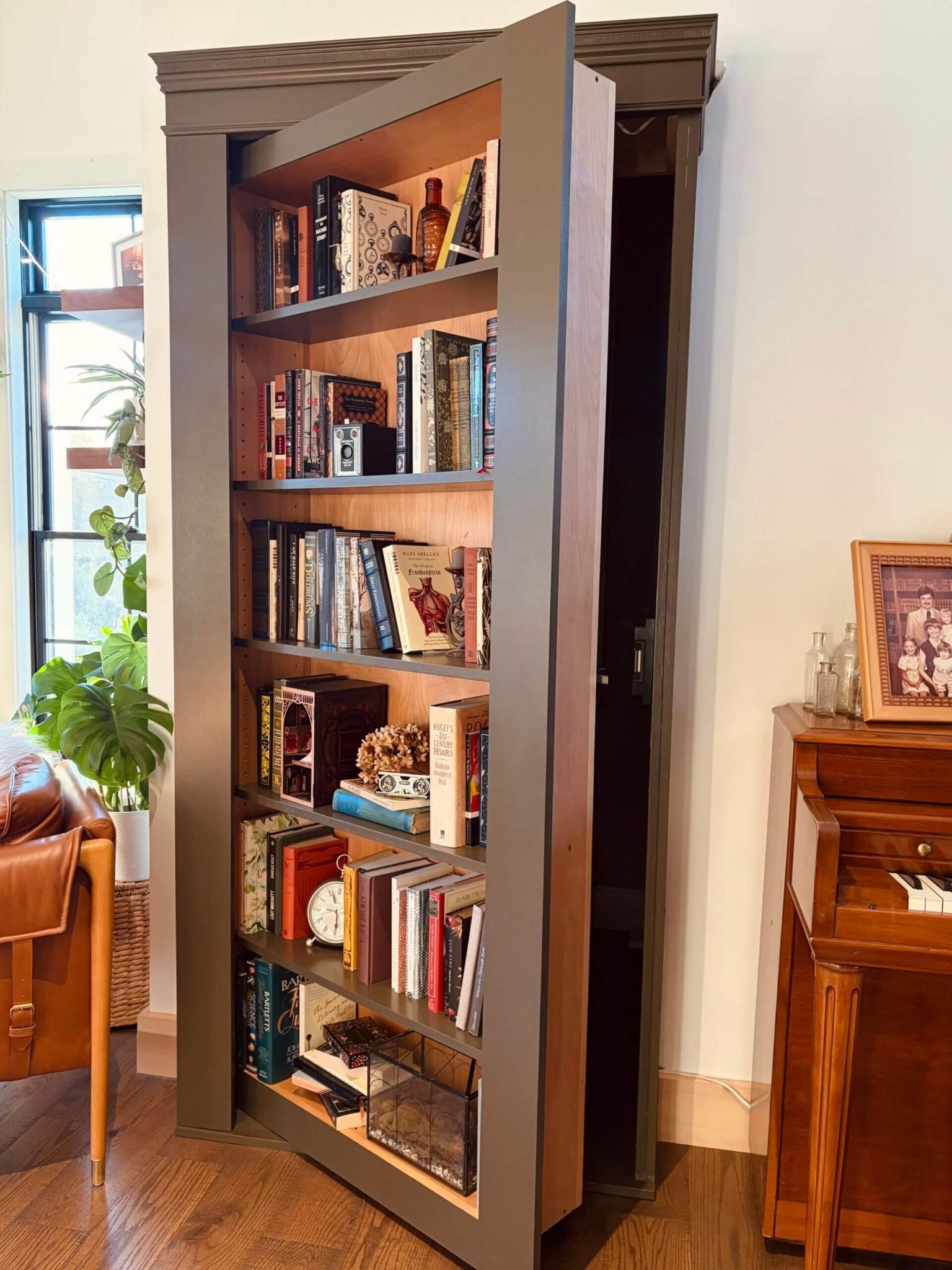
The physical footprint required for operation dictates whether a custom sliding bookcase door or a hinged system will integrate into the existing floor plan without structural modifications.
A sliding configuration requires unobstructed, adjacent wall space equal to or greater than the entire width of the door itself. Homeowners frequently underestimate this lateral clearance requirement. The adjacent wall must be free of framed pictures, potted plants or even raised light switches, as they can keep the door from opening.
Heavy sliding doors hang from or ride along tracks, so the surrounding wall headers and floor joists must be engineered to handle the concentrated lateral weight transfer.
Hinged doors require an empty radius in front or behind the opening to accommodate the pivot path. Determining the swing direction depends on the target room’s square footage. An out-swing configuration is ideal for a compact space, as an in-swing door would reduce the usable area inside the secret room.
Standard accessibility and building codes also require maneuvering clearances to ensure safe, unimpeded entry. Commercial guidelines mandate a space at least 60 inches deep in front of the door for forward approaches. It’s a great baseline for residential traffic flow.
The goal of any hidden bookcase entrance is to disguise a security barrier as ordinary room architecture. Whether the space demands floor-to-ceiling shelving, arched molding or a specific wood species, a custom bookcase door can be fabricated to mimic existing room trim.
You can upgrade the door systems with integrated LED lighting, hidden biometric scanners or concealed magnetic hover switches to turn them into elite luxury home features. Browse portfolios to compare different secret bookcase doors to better understand how trim, shelving depth and hardware concealment affect the final illusion.
A concealed bookcase door is a perimeter defense asset. The effectiveness of a safe room or secure vault relies on the entrance’s integrity and invisibility.
High-net-worth properties require advanced threat mitigation because break-ins are not the only concern. Reports show that custom bookcase doors for secret room applications must withstand targeted attacks, as 33% of burglars spend days gathering intelligence on targets. Plus, in emergencies, a door’s visibility can also invite attacks. Experts note that visible, unsecured doors are vulnerable points during invasions and high-threat scenarios. Hiding a door neutralizes this risk.
For maximum defense, the door’s core must withstand severe brute force. Creative Home Engineering‘s vault doors offer reinforced protection with ballistic-rated steel for lasting integrity. They’re suspended on precision hinges or tracks to ensure the weight doesn’t compromise the smooth operation or tight reveals necessary to maintain the illusion.
Off-the-shelf hidden doors cannot adapt to the structural realities of high-end homes, which often feature vaulted ceilings, curved walls or nonstandard framing dimensions. Designing a hidden bookcase door for a home office or specialized secure storage requires tailored engineering.
Predesigned doors from budget retailers cannot accommodate complex requirements like thresholdless entries and multidoor or double-bookcase configurations. They’re also notorious for sagging and developing gaps over time. This destroys the illusion of a secret bookcase door.
True architectural integration involves precise fabrication based on exact site measurements. A custom hidden door is tailored specifically to match your home’s architecture and decor. Engineering and production lead times can often take around 12 weeks or more. The period ensures the final unit fits flawlessly into its intended installation point, whether it’s a standard hidden bookcase door or an elaborate dual-entry system.
Accommodating unusual layouts can force the sliding vs. hinged bookcase door debate to the forefront, especially when dealing with extreme weights or tight access corridors. To overcome these hurdles, experts may recommend complex motorized and automated solutions. A custom engineering team will evaluate the structural loads to determine if a heavy-duty sliding track system or a low-friction pivot analog is best.
Adding luxury hidden doors to your home is an investment in security, acoustic privacy, and smart architectural design. Start by securing the right engineering expertise. Contact the team today to discuss structural parameters and security threat levels.