
If you’ve ever considered adding a secret passage beneath your stairs, you’ve probably realized it’s not as simple as installing a standard door. A staircase hidden door combines architectural, engineering and problem-solving techniques. When it works, it feels effortless. When it doesn’t, it becomes expensive, unsafe or impossible to use. Discover how to make the most of this unique feature.
A stair system is one of the most underutilized areas in a home. That unused volume beneath or behind the stairs can become something far more functional with the right approach.
Building a secret door into a stairwell reclaims dead space and turns it into a purposeful feature without altering your home’s visible layout. Instead of adding square footage, you’re taking what’s already there and repurposing it innovatively.
Design is a key factor in fabricating a well-executed custom secret door, which can become a focal point without announcing its presence. It blends into the architecture while still delivering a sense of wonder. That balance between custom concealment and impact is what makes staircase installations stand out compared to standard camouflaged panels.
The function behind a staircase hidden door often determines how the entire system is built. Each use case comes with different structural and mechanical requirements.
A hidden staircase door conceals storage without disrupting your main living space. This works well for seasonal items, valuables or collections that you don’t want visible.
Security concerns have shifted in recent years, and more homeowners are planning for controlled-access spaces, A high-security door integrated into a staircase offers both concealment and protection.
If it’s designed as a reinforced safe room, it can protect your family during a home invasion. In this case, access control, locking systems and emergency exit planning become critical.
Remote work has increased the demand for quiet, enclosed work-from-home areas. A secret system can lead to a workspace that feels separate and can even be soundproofed without requiring a full renovation or addition.
Before you commit to a project, you need to evaluate whether your space can support it.
A lifting stair structure follows an arc as it opens. That means you need space for the closed position and also for the full range of motion. Tight clearances often lead to rubbing, poor alignment, and visible gaps.
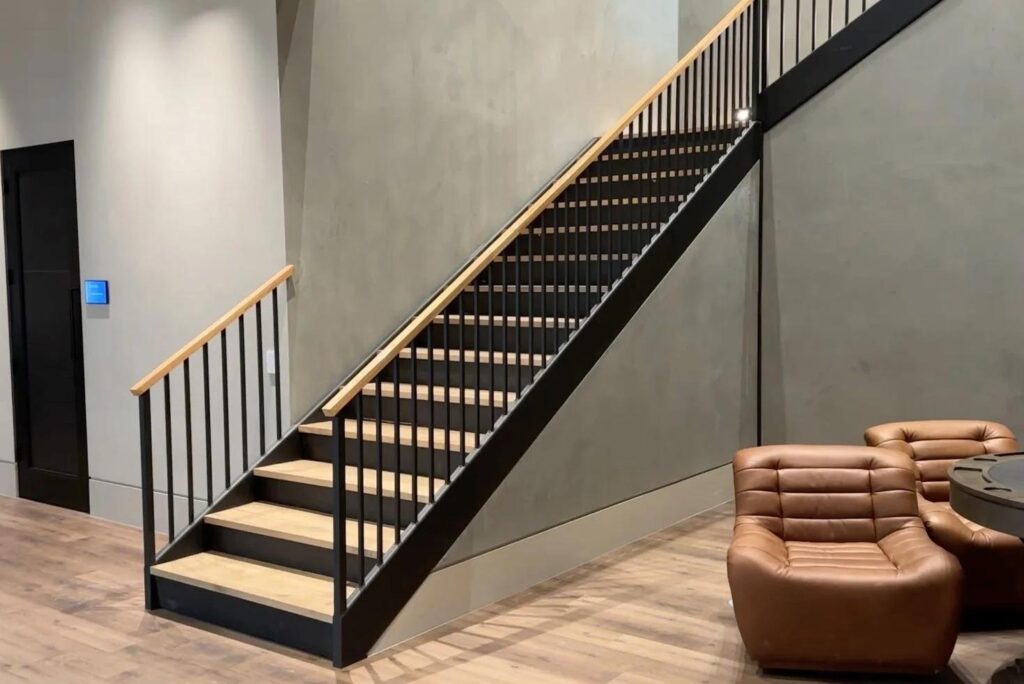
Stairway systems are heavy and can weigh hundreds of pounds. A poorly planned unit becomes difficult or impossible to open. The goal is not to use brute strength to haul the cover up, but rather to apply fingertip balance when opening or closing.
Choose whether your system will lift or swing. Will it use assisted or motorized movement? Projects fail because homeowners are preoccupied with the finish, believing they can add the opening mechanism afterward.
A secret door only works when it blends in, disappearing into your home’s aesthetic. Attention to the trim, wall alignment and surface materials makes this possible. Since walls are rarely perfectly flat, it takes skill to achieve a tight, consistent reveal.
Regardless of the overall aesthetics of your staircase hidden door, within a staircase, it must meet the same or higher standards as any structural element in your home.
These include:
A complex custom door often needs professional collaboration. If the stairs form part of a new construction or are scheduled for a major renovation, bringing in specialists early allows them to coordinate to best meet the project scope.
Installing during construction gives you flexibility. Retrofitting limits your options and can significantly increase costs.
A staircase hidden door is more than a cover — it’s a machine. And like other mechanical items, it depends on precision. Exact measurements are vital, and even small miscalculations affect alignment, movement and concealment. This is where detailed design work, often using CAD, becomes essential.
Balanced force systems must make panels feel almost weightless during operation. That doesn’t mean these are light, but rather that the forces acting on them are carefully balanced. The load may increase at certain angles or positions. Systems counter this by using components like gas struts. These must be precisely positioned to match the changing force curve.
It may seem logical to use a stronger motor to lift a heavier weight, but in practice, that creates risk. High-force systems can cause serious injury to users if someone gets caught in the mechanism. Instead, engineered systems aim for low-force operation. That way, if there’s an obstruction, the system won’t cause harm.
Precision components and careful calibration prevent camouflaged doors from sagging and becoming difficult to use over time.
A staircase hidden door combines design, structure and engineering in a way few home features do. Beyond creating a secret space, it’s key to make that area safe, functional and reliable for long-term use.If you’re planning a custom secret door, the decisions from the start matter. Early planning ensures success, while cutting corners can lead to costly mistakes. Contact the team today to ensure the system is designed as a complete unit.